CONTINUOUS ENCRYPTION FOR ENTERPRISE AI

The AI Encryption Layer

Run AI on your most sensitive data without ever exposing it in plaintext.

FHEnom for AI™ keeps your datasets, model weights, prompts, and outputs encrypted throughout the AI lifecycle. Deploy across cloud, on-prem, and edge infrastructure while retaining control of the data and IP that create your advantage.

100% Encrypted. 0% Plaintext. Confidential AI.

FHEnom for AI™
FIPS 140-3 Validated
Quantum-Resistant by Design
Zero Plaintext
Zero Performance Hit
HOW FHENOM FOR AI™ WORKS

Continuous Encryption Across the Entire AI Pipeline

01

Encrypt the Model

Model weights, parameters, tensors, and architecture are encrypted using FHE. Existing pre-trained models or new foundation models can be encrypted and deployed to any infrastructure — cloud, on-prem, or edge.

02

Encrypt the Data

Prompts and queries are encrypted at the trust boundary using an ephemeral session key. Data never leaves your logical control in plaintext.

03

Compute on Ciphertext

Optimized FHE engine processes data directly on GPU cores – no decryption at any stage. Tensors and KV cache remain encrypted throughout inference. Optional TEE integration available for hardware-hardened key custody.

04

Return Encrypted Results

Inference outputs are generated in encrypted form and returned to the client. Only the session key holder decrypts. Zero exposure at any point.

The Problem

AI Compresses Your Company's Knowledge Into a Model

0%

of employee AI inputs now contain sensitive data – up from 11% in 2023

0K+

enterprise AI credentials found on the dark web in 2025

0%

of IT leaders report concern about data exposure through AI tools

Every dataset you feed AI – customer data, financial records, internal documents — contributes to a model that represents your organization’s collective knowledge. That makes AI models one of the most concentrated assets in the enterprise. Yet most AI systems process that data without encryption. The model, the prompts that query it, and the outputs it generates all exist unprotected during inference — the exact moment they’re most valuable and most vulnerable.

AI Data Classification

Four Tiers of AI Data Security

Not all data requires the same level of protection. But when the classification demands it, only one tier delivers zero plaintext exposure.

TIER 1 – PUBLIC

Standard Cloud AI

DATA TYPES

Open-source datasets, public knowledge bases, anonymized marketing data.

ACCEPTED SECURITY

Encryption at Rest and in Transit only.

THE PLAINTEXT REALITY

Data is plaintext in CPU, GPU, Bus, and Memory.

VENDOR FIT

OpenAI, Standard AWS / Azure / GCP

TIER 2 – INTERNAL

Basic Hardware CC

DATA TYPES

Routine operational analytics, internal communications, low-risk business logic.

ACCEPTED SECURITY

Intel TDX, AMD SEV – CPU-level TEE isolation.

THE PLAINTEXT REALITY

Decrypted inside the CPU enclave. Plaintext on the bus.

VENDOR FIT

Standard TEE Wrappers
Confidential Computing

TIER 3 – CONFIDENTIAL

Advanced Hardware CC

DATA TYPES

Standard PII, generalized financial metrics, basic SOC2 compliance workloads.

ACCEPTED SECURITY

Advanced Confidential Computing with GPU-level encryption.

THE PLAINTEXT REALITY

Encrypted in VRAM, but still decrypted at the cores for computation.

VENDOR FIT

Elite CC Providers
Confidential Computing

TIER 4 – RESTRICTED

Encrypted Execution

DATA TYPES

Regulated PHI (HIPAA), cross-border finance, sovereign data, pharma R&D, model IP

ACCEPTED SECURITY

FHEnom for AI™ – Continuous Fully Homomorphic Encryption.

THE PLAINTEXT REALITY

Zero Plaintext. Computation occurs entirely on ciphertext.

VENDOR FIT

DataKrypto

What's Unprotected Below Tier 4

Prompts & Queries

Business logic, PII, and strategic questions – decrypted during every inference cycle.

Model Weights & IP

Your most valuable AI asset, sitting unprotected in GPU memory

Inference Outputs

Predictions, classifications, and generated responses – produced in the clear

Training Data

Datasets used fine-tuning and RAG, decrypted for processing

Multi-Party Data

Cross-organizational data requiring every party to trust the enclave provider

At Tier 4, none of these ever leave encryption.

What happens if you choose the wrong tier?

A CISO classifies their organization’s most sensitive assets — sovereign data, pharmaceutical IP, trade secrets — as Restricted. They evaluate AI security solutions and select a Tier 3 provider: advanced Confidential Computing with hardware-level GPU encryption.

The CISO authorized Restricted data to leave the organization under Tier 3 protection. The data required Tier 4. The breach isn’t a technology failure — it’s a classification mismatch.

STEP 1 — ASSESSMENTThe CISO evaluates the Tier 3 solution. Hardware enclaves, encrypted VRAM, attestation — it looks solid. The security team approves sending Restricted data to the third-party AI platform.
STEP 2 — DEPLOYMENTRestricted data leaves the organization. It enters the third-party infrastructure and is decrypted at the GPU cores for computation. The data exists in plaintext during every inference cycle.
STEP 3 — BREACHThe third party is compromised. An insider or a side-channel exploit extracts data from GPU memory during computation. Because Tier 3 still decrypts at the cores, the plaintext was there to steal.

Tier 4 eliminates this risk entirely. With FHEnom for AI™, the data never exists in plaintext — not in memory, not at the cores, not anywhere on the infrastructure. Even if the third party is fully compromised, the attacker gets ciphertext. There is nothing to steal.
SEE THE DIFFERENCE

The Evolution of AI Data Security

Follow a single inference request across the three architectures. See how hardware isolation fails at the software layer – and how encrypted execution solves it.

Tier 2

Standard CPU Enclaves

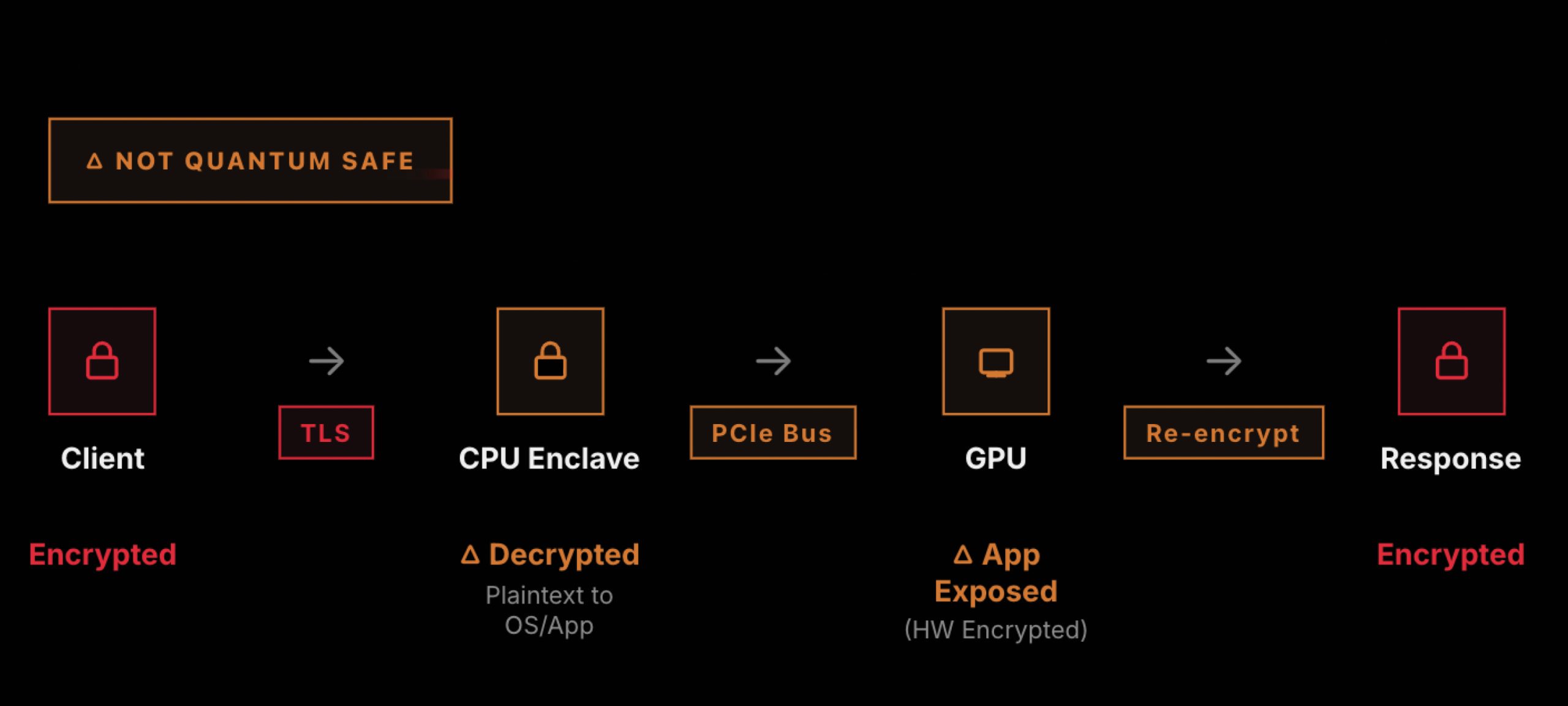
The standard Confidential Computing model (Intel TDX, AMD SEV). Data is decrypted at the CPU. The entire downstream pipeline is exposed.

⚠ Data leaks across the PCIe bus, VRAM, and GPU execution cores.

Client
Encrypted
→
TLS
CPU Enclave
△ Decrypted
Plaintext to OS/App
→
PCIe Bus
GPU
△ App Exposed
(HW Encrypted)
→
Re-encrypt
Response
Encrypted
△ NOT QUANTUM SAFE

Tier 3

Advanced CC (NVIDIA)

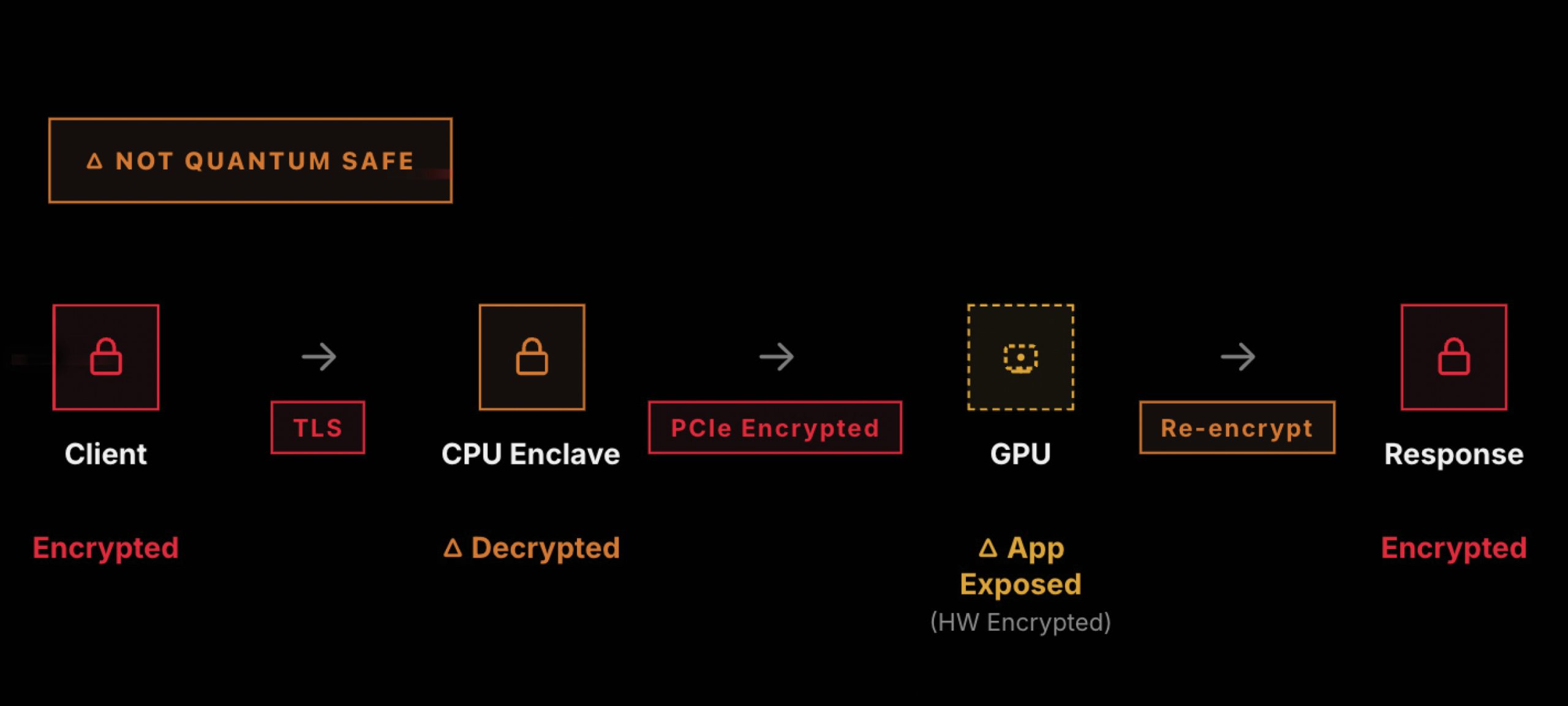
Blackwell (B200) architectures encrypt the PCIe bus and VRAM physically, but the data is still decrypted for the software layer to process it.

⚠ Hardware is secure, but a breached application or OS yields pure plaintext.

Client
Encrypted
→
TLS
CPU Enclave
△ Decrypted
→
PCIe Encrypted
GPU
△ App Exposed
(HW Encrypted)
→
Re-encrypt
Response
Encrypted
△ NOT QUANTUM SAFE

Tier 4

Encrypted Execution

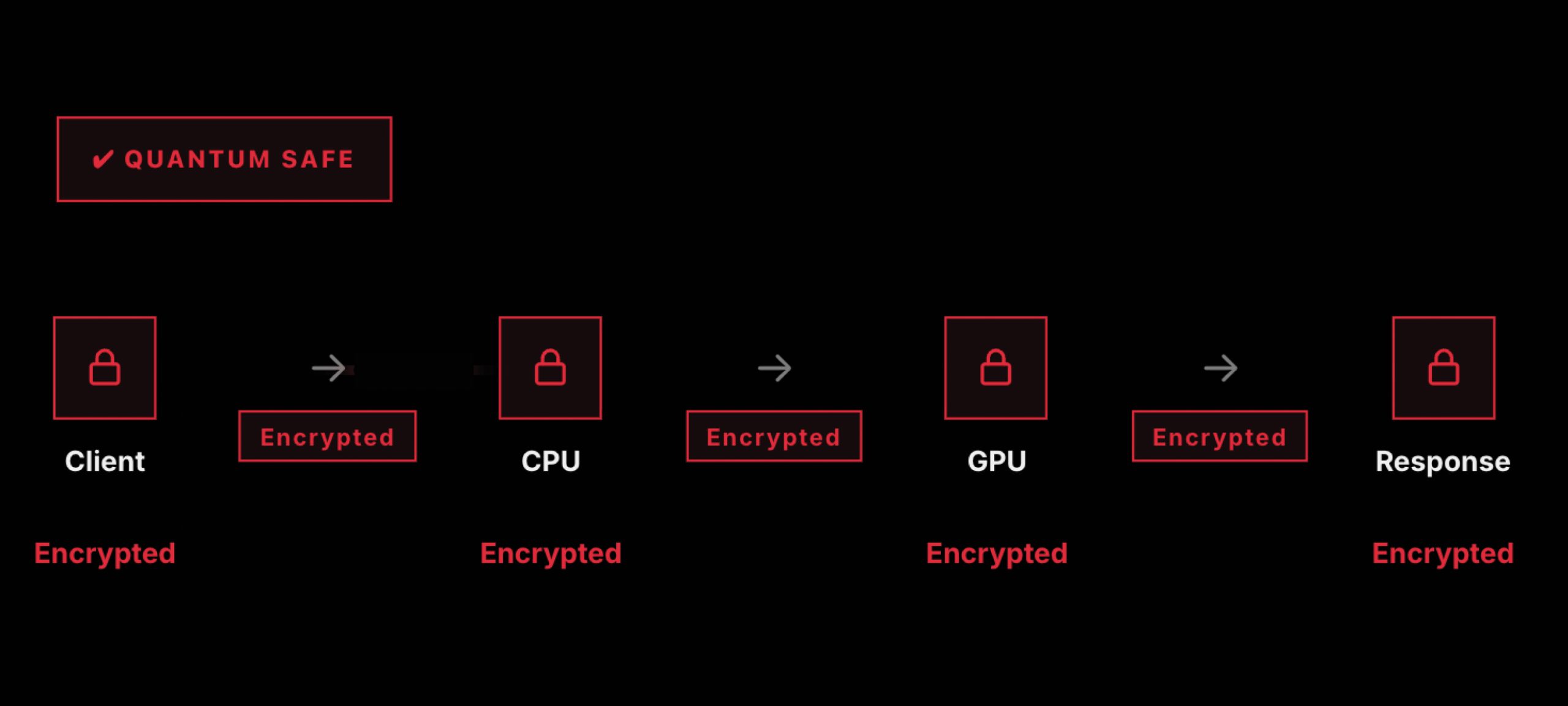
FHEnom for AI™ replaces hardware isolation with math. The prompt and the model weights remain ciphertext inside the memory, inside the OS, and inside the GPU cores.

✔ Zero Plaintext. A breached application yields only mathematically secure ciphertext.

Client
Encrypted
→
Encrypted
CPU
Encrypted
→
Encrypted
GPU
Encrypted
→
Encrypted
Response
Encrypted
✔ QUANTUM SAFE

Tier 2

Standard CPU Enclaves

The standard Confidential Computing model (Intel TDX, AMD SEV). Data is decrypted at the CPU. The entire downstream pipeline is exposed.

⚠ Data leaks across the PCIe bus, VRAM, and GPU execution cores.

Client
Encrypted
→
TLS
CPU Enclave
△ Decrypted
Plaintext to OS/App
→
PCIe Bus
GPU
△ App Exposed
(HW Encrypted)
→
Re-encrypt
Response
Encrypted
△ NOT QUANTUM SAFE

Tier 3

Advanced CC (NVIDIA)

Blackwell (B200) architectures encrypt the PCIe bus and VRAM physically, but the data is still decrypted for the software layer to process it.

⚠ Hardware is secure, but a breached application or OS yields pure plaintext.

Client
Encrypted
→
TLS
CPU Enclave
△ Decrypted
→
PCIe Encrypted
GPU
△ App Exposed
(HW Encrypted)
→
Re-encrypt
Response
Encrypted
△ NOT QUANTUM SAFE

Tier 4

Encrypted Execution

FHEnom for AI™ replaces hardware isolation with math. The prompt and the model weights remain ciphertext inside the memory, inside the OS, and inside the GPU cores.

✔ Zero Plaintext. A breached application yields only mathematically secure ciphertext.

Client
Encrypted
→
Encrypted
CPU
Encrypted
→
Encrypted
GPU
Encrypted
→
Encrypted
Response
Encrypted
✔ QUANTUM SAFE

Tier 2

Standard CPU Enclaves

The standard Confidential Computing model (Intel TDX, AMD SEV). Data is decrypted at the CPU. The entire downstream pipeline is exposed.

⚠ Data leaks across the PCIe bus, VRAM, and GPU execution cores.

Standard CPU Enclaves mobile diagram

Tier 3

Advanced CC (NVIDIA)

Blackwell (B200) architectures encrypt the PCIe bus and VRAM physically, but the data is still decrypted for the software layer to process it.

⚠ Hardware is secure, but a breached application or OS yields pure plaintext.

Advanced Confidential Computing mobile diagram

Tier 4

Encrypted Execution

FHEnom for AI™ replaces hardware isolation with math. The prompt and the model weights remain ciphertext inside the memory, inside the OS, and inside the GPU cores.

✔ Zero Plaintext. A breached application yields only mathematically secure ciphertext.

Encrypted Execution mobile diagram

TECH NOTE Why aren’t Tiers 2 & 3 quantum safe? TEE security relies on RSA/ECDSA for attestation and Diffie-Hellman for key exchange — all vulnerable to Shor’s algorithm. These cryptographic primitives are baked into the hardware at manufacturing and cannot be upgraded to NIST post-quantum standards without new silicon — a multi-year hardware refresh cycle. FHEnom for AI™’s encryption is quantum-resistant by mathematical design. No new hardware. No migration. No NIST retrofit required.

SOVEREIGN AI

Your Data. Any Cloud. Zero Exposure.

Data sovereignty regulations require that sensitive data never leave jurisdictional control — but on-prem GPU capacity is finite. Cloud burst is the answer, except it means trusting a third-party provider with your plaintext.

FHEnom for AI™ eliminates the trade-off. Data is encrypted before it leaves your premises and stays encrypted throughout processing on any cloud, in any jurisdiction. The cloud provider processes ciphertext – they cannot see the data, the model, or the results. Sovereignty is maintained mathematically, not by hardware attestation in a foreign datacenter.

Jurisdiction-Agnostic

Process data in any cloud, any country. Jurisdictional access laws are irrelevant when there’s no plaintext to access.

On-Prem to Cloud Burst

Extend capacity to cloud without re-architecting. FHEnom for AI™ handles encryption transparently at the boundary.

No Hardware Trust Required

Sovereignty doesn’t depend on Intel, AMD, or NVIDIA attestation. Mathematical protection works on any hardware, anywhere.

THE FHENOM FOR AI ADVANTAGE

What Encrypted Execution Delivers

Uncompromised Security

No decryption. No plaintext window. No side-channel exposure. Mathematical certainty, not hardware trust.

Zero Accuracy Loss

FHEnom for AI™ delivers bit-exact results—in FP32 deterministic mode, the encrypted model produces word-for-word identical outputs to its plaintext counterpart. Encryption adds security, not noise.

Deploy Anywhere

Cloud, on-prem, edge, or multi-party environments. Infrastructure becomes trusted by design—because it never sees your data.

Compliance by Architecture

Encryption is provable at every stage — audit trails are cryptographically verifiable

Secure Autonomous AI

Agents only process encrypted data. What they can’t see, they can’t leak.

Performance at Scale

The only added latency is ~0.6ms for encryption and decryption of a 2K-token prompt and response (4K tokens total). That’s not a trade-off. That’s a rounding error.

Data Residency & Sovereignty

Process data globally while remaining legally local. Encryption at the source allows you to use any cloud jurisdiction without violating localization mandates or sovereign data laws.

Blog

When the Agent Becomes the Exfiltration Path

An AI agent doesn’t need bad intent to become an exfiltration path. It only needs a route nobody anticipated, as recent incidents at OpenAI show. Paolo Campoli explains why trying to predict every path falls short, and what enterprises should focus on instead.

Read More »
October 1, 2026

Confidential AI doesn't have to wait another day.

Experience FHEnom for AI™ in action.

BOOK A DEMO
ISO 27001 Information Security certified FIPS 140-3 validated, certification 5175 TiE50 2026 Winner