
In agentic transformation, value arises from the convergence of three elements: selecting use cases carefully, recognizing and building your own Capital Intelligence, and managing costs.
Many companies today use generative artificial intelligence, GenAI , but still few have adopted the right strategies to gain a real competitive advantage from it.
According to Deloitte’s State of AI in the Enterprise report, the share of leaders seeing a “transformative” impact from AI has risen to 25%, more than double the previous year, yet only 20% of organizations already report revenue growth. And while 74% of leaders plan to use agents by 2027, only one in five companies currently has mature agent governance. In short, the technology has spread much faster than the ability to extract value from it.
The experience gained in many projects with companies, taken up more extensively by Datakrypto, has highlighted the difference between those who create value and those who remain stuck with the “pilots.” And the differentiating factor isn’t a single ingredient, but the convergence of three elements.
The first is discipline in choosing, identifying the use cases that truly drive a business indicator and reorganizing the data that feeds them. AI without data, to use an image, is a powerful engine mounted on a car without wheels.
The second is what has been defined as “Capital Intelligence,” the company’s operational knowledge, the rules, exceptions, and judgment criteria that previously resided in people’s heads, and which AI converts into a codified asset—through the combination of Agents, workflows, LLM models, and more—the most valuable and the most difficult to imitate. Note the verb. AI doesn’t “create” that knowledge, it “converts” it from implicit assets to strategic capital.
The third is mastery of economics , that is, understanding and optimizing the real cost of “running AI,” now that the unit of consumption is the “token,” the small block of text that models process, rather than the license or server. The key parameter is not the cost per token, but the cost per useful result. And the largest language model (LLM) isn’t always needed. For example, research reported by Stanford shows that a small model, with light fine-tuning, can increase accuracy from 41% to 78% on a narrowly defined task. Often, what’s needed is the right one, not the most powerful one.
Hence a fourth, more silent consequence: the more this system functions, the more valuable and, at the same time, more exposed the Capital Intelligence at its core becomes.
On this foundation, Deloitte has built Solaria , its proprietary agent platform. It is both a marketplace and a framework that orchestrates over 1,000 intelligent agents configured by Deloitte professionals to automate and redesign complex processes. It allows even non-code users to create new ones, adopting a “no-code” approach, and provides governance, security, and cost control.
However, one important point remains. Data is generally well protected when it is “at rest” and “in transit,” encrypted in the drawer and shipped in a secure package. But when the agent uses it and processes it with the LLM model, it reverts to plain text, like a letter that must be reopened to be read. This is the window that the perimeter, disk encryption, and in-transit encryption do not close. This is precisely the problem DataKrypto addresses with its “Confidential AI” approach: extending encryption to the data and the model even while they are in use, across the surfaces of an agentic architecture, and also protecting the trained LLM model, which contains valuable business knowledge. In essence, it closes an exposure that other controls and systems leave open. In this sense, DataKrypto is a natural complement to Solaria: if Solaria builds and orchestrates value, the Confidential AI solution protects it while it works.
The summary, then, is simple. Carefully select use cases, recognize and build your Capital Intelligence, manage costs: everything is necessary, nothing is sufficient on its own. The advantage remains ours only as long as the asset that generates it remains ours, and it remains ours only if it is protected even while in use.
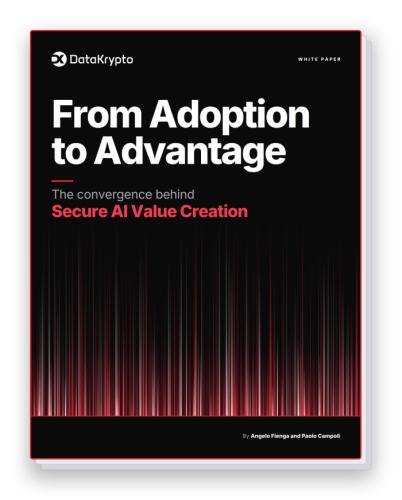
For those who want to read the complete analysis with data, cases and references, see: From Adoption to Advantage: The Convergence Behind Secure AI Value Creation – DataKrypto
We thank Angelo Fienga, GenAI Senior Advisor at Deloitte, for his contribution to the article.
See the blog as originally published, in Italian, by Deloitte here.